


Available - Phone for Price
Accuphase
Accuphase T-1200 FM Tuner
Accuphase T-1200 FM Tuner
Couldn't load pickup availability
Quick Info
Reference Quality FM Tuner
Double-Tuned Front End, Variable Bandwidth IF Filter
DS-DC Achieves Ideal Stereo Demodulation with DSP Technology
High Quality Champagne Finish, Remote Control, 20 Station Memory Presets

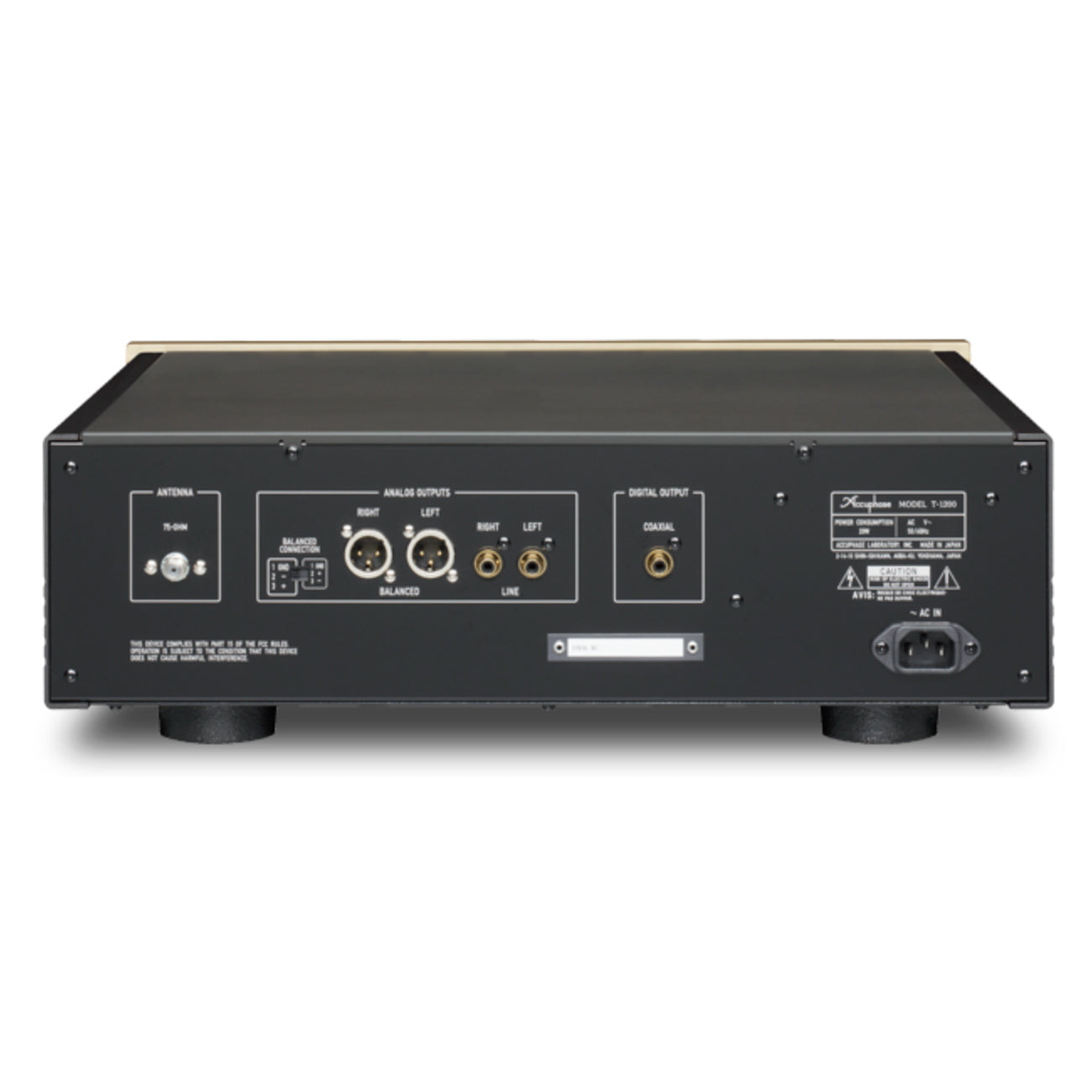
Accuphase T-1200 FM Tuner with Double-Tuned Front End
Using a blend of latest RF circuit design with sophisticated digital signal processing, most major functions after the intermediate frequency stage such as the variable bandwidth IF filter, multipath reduction, digital FM demodulator and DS-DC stereo demodulation have been moved to software on the DSP chip. Manual tuning using the pulse tuning method, plus 20-station memory tuning. A digital output provides further flexibility. Realizing impeccable sound quality and outstanding performance in an easy to use format, this FM tuner has been developed for demanding audio and music connoisseurs.
Double-Tuned Front End Easily Handles High Signal Levels
The front end not only must provide selectivity for weak radio signals, it also needs to competently handle broadcast stations with strong field strength and convert the signal to the intermediate frequency (IF) while suppressing interference and distortion. The T-1200 performs these tasks brilliantly, thanks to a double-tuned circuit with excellent selectivity characteristics, placed before the RF amplification stage. This proactively prevents intermodulation distortion and blocking which can otherwise occur with strong input signals. The two-stage design with another double-tuned circuit after the RF amplifier further bolsters performance, resulting in excellent sensitivity and selectivity. The double-balanced mixer with differential input also employs a two-stage topology, forming a double super heterodyne circuit. Any type of interference signal is reliably blocked before IF conversion.
Revolutionary Local Oscillator Principle: DDS (Direct Digital Synthesis)
The mixer combines the signal from the antenna input with the signal from a local oscillator for conversion into the intermediate frequency (IF). The local oscillator in the T-1200 is a DDS (Direct Digital Synthesis) circuit. In a conventional PLL (Phase Locked Loop) circuit, feedback is used to stabilize the frequency, but this produces frequency modulation components that tend to degrade S/N ratio. With DDS on the other hand, the output of a quartz oscillator is divided to create the digital signal timing that governs the readout of sine wave data and the operation of the D/A converter which produces the analogue waveform output. Because there are no frequency modulation components, a highly pure signal with outstanding S/N ratio is created by this revolutionary circuit.
Variable Bandwidth IF Filter Improves Interference Performance
The IF Bandwidth selector of the T-1200 provides a choice of six settings (50, 75, 100, 150, 250, 500 kHz). Normally, a wider bandwidth setting is preferable in terms of performance characteristics, but by restricting the bandwidth, noise can be reduced in certain situations, making it easier to obtain a good quality signal from a station affected by interference from a strong adjacent station.
The variable bandwidth IF filter is implemented using a FIR (Finite Impulse Response) type digital filter with perfectly linear phase characteristics, thereby eliminating the phase shift that can occur with conventional IF bandwidth filters.
Multipath Reduction (MPR) Function Minimizes Reflections
Multipath reception refers to a condition where the same broadcast signal reaches the antenna via several different propagation routes. In the case of FM, this occurs when the signal travels to the antenna in a straight line, but is also reflected and therefore slightly delayed by buildings, mountains or other tall obstructions. When the direct waves and reflected waves are received together, distortion and noise occur.
The high-speed, high-precision DSP chip in the T-1200 makes it possible to perform multipath reduction (MPR) through signal processing that effectively suppresses the harmful reflected components. This technique, which is based on adaptive filtering principles, greatly reduces reflected wave components and ensures that only the desirable direct wave components are received, resulting in high-quality audio output.
Digital FM Demodulator Keeps Distortion and Noise to a Minimum
The FM demodulator circuit is a crucial component that has a significant effect on distortion and noise characteristics of the tuner’s audio output. In the T-1200, the imaginary part of the digitized FM signal is divided by the real part to extract the tangent of the phase angle (θ). By calculating the arctangent from this, the phase angle can be determined. Differentiation is then used to obtain the time variation of the phase angle resulting in the FM demodulated output (audio output).
Memory Presets for 20 Stations
The station buttons make it easy to store and recall up to 20 broadcast stations. The settings for Mute, Mode, Local, Multipath Reduction and IF Bandwidth are also stored at the same time, making it possible for example to memorize different settings for various reception conditions and instantly access them as needed.
DS-DC Achieves Ideal Stereo Demodulation with DSP Technology
The stereo demodulator in the T-1200 features a principle called DS-DC (Direct Synthesis – Double Cancellation). The demodulator comprises the two technologies described below. Since all operations are carried out in the digital domain through software-based algorithms in the DSP chip, ideal stereo demodulation performance can be achieved, resulting in amazingly high channel separation.
Pilot Tone Direct Synthesis
A conventional FM tuner uses a PLL circuit to extract the pilot tone and obtain the frequency and phase components from the input signal (stereo-modulated signal). If the level of the pilot tone decreases, noise will be heard and stereo separation becomes extremely poor. With DS-DC, the pilot tone in the input signal is identified and directly generated by the DSP arithmetic. Therefore, even when there is a high level of noise, pilot tones can be reliably generated. This means that impressive stereo separation is achieved also at low pilot tone levels.
Crosstalk Double Cancellation
After the input signal has been separated into the left and right components, the circuit eliminates crosstalk using a dual approach that also takes phase components into consideration. The result is extremely thorough left/right separation.
Remote Commander RC-430
Enables control of all tuner functions except power on/off. Also allows volume control with Accuphase amplifiers.
Why Choose The Accuphase T-1200 FM Tuner?
The Accuphase T-1200 is one of those rare FM tuners that reminds you just how enjoyable radio can be, blending cutting-edge tech with a wonderfully tactile, old-school listening experience. Its double-tuned front end and clever DDS local oscillator work together to deliver an ultra-pure signal that shrugs off interference, while the advanced DSP takes over from the IF stage onwards - handling everything from variable-bandwidth filtering to multipath reduction and pristine DS-DC stereo demodulation. The result is FM that sounds improbably clean and spacious, even in challenging reception areas. Add in pulse-style manual tuning, 20-station memory, and a handy digital output, and the T-1200 feels both lovingly traditional and impressively modern - an FM lover’s dream that treats every broadcast like a high-quality source.
Main Features & Specifications
Note: Features & Specifications Subject To Change Without Notice. E&OE.
Product Reviews
Questions & Answers
